When launching or scaling an affiliate marketing program, one of the most critical questions brands face is: "How much should I actually pay my affiliates?" The answer isn't as simple as copying a competitor's rate or picking a percentage that feels comfortable. Your affiliate commission budget needs to be strategic, margin-aware, and flexible enough to attract high-performing partners while maintaining profitability.
In this guide, we'll break down exactly how to budget for affiliate commissions in your industry, using data-driven benchmarks and unit economics to build a sustainable program that scales.
Understanding Industry Benchmarks: Your Starting Point
Affiliate commission rates aren't one-size-fits-all. They vary significantly across industries based on product margins, customer lifetime value, and competitive dynamics. Here's what typical commission structures look like across major verticals:
Health, Wellness & Beauty products typically offer 15–30% commissions, reflecting moderate to high margins and strong repeat purchase potential. Apparel & Accessories brands usually sit in the 10–25% range, balancing competitive pricing with volume-based sales. Education & Digital Products command the highest rates at 30–50%, thanks to minimal fulfillment costs and high profit margins.
Home & Lifestyle products generally fall into the 10–20% bracket, while Supplements often pay 20–35% due to subscription models and strong customer retention. Telehealth and Subscription Services frequently use cost-per-acquisition (CPA) models, typically ranging from $50–$150 per customer, rather than percentage-based commissions.
These benchmarks provide valuable context, but they're just the starting point. Your actual commission rate should be driven by your specific margins and the caliber of affiliates you want to attract.
Building Commissions Around Your Unit Economics
The most innovative brands don't pick commission rates based solely on industry averages; they work backward from their fundamental business metrics. This approach ensures your affiliate program drives profitable growth rather than vanity revenue.
Start by determining your gross profit per order or customer. Calculate your average order value (AOV), subtract your cost of goods sold (COGS), and you'll have your gross profit baseline. Next, decide what percentage of that profit you're willing to allocate toward customer acquisition. This becomes your commission budget ceiling.
For example, if your AOV is $100, your COGS is $40, you're left with $60 in gross profit. If your target acquisition cost is $20 (roughly one-third of profit), that translates to a 20% commission rate or a $20 CPA equivalent. This mathematical approach ensures your affiliate payouts scale profitably with your business, not based on emotions or guesswork.
Tailoring Commissions to Partner Types
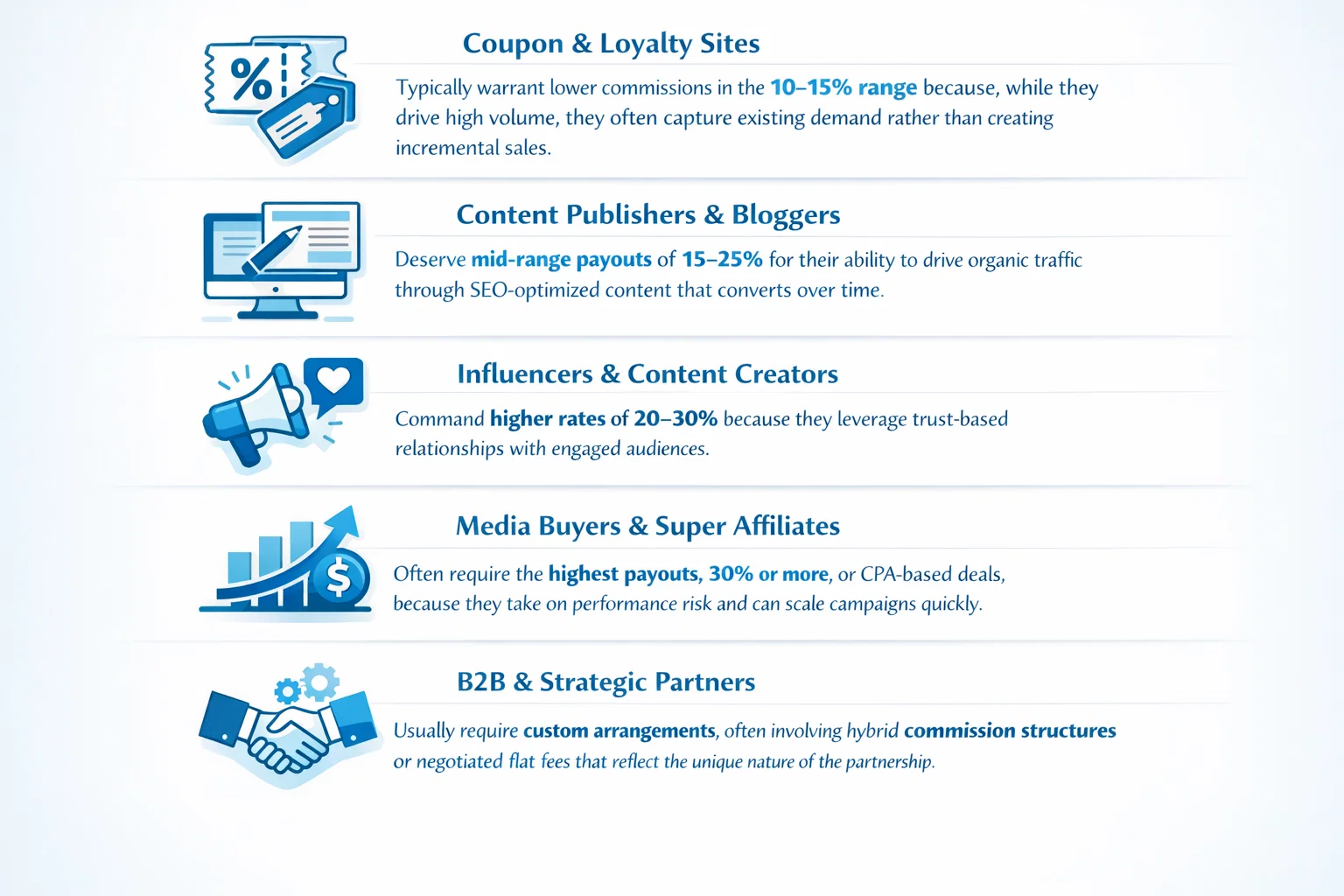
Not all affiliates deliver the same value, and your commission structure should reflect this reality. A flat-rate commission for every partner type leaves money on the table, either by overpaying for low-value partners or underinvesting in high-performing ones.
Incorporating Bonuses and Flat Fee Structures
If you want premium placements in competitive spaces, think holiday gift guides, major newsletter features, or influencer spotlight campaigns, standard commissions alone won't secure them. Top-tier affiliates expect layered compensation structures.
Be prepared to offer placement fees ranging from $1,500 to $10,000 for high-visibility opportunities, such as Q4 shopping guides. CPA bonuses of $50–$100 can incentivize affiliates to scale successful campaigns. Performance-based commission boosts for partners who hit monthly revenue targets create win-win scenarios, where your top performers earn more as they drive increased sales.
Premium placements and top-performing affiliates won't scale on base commissions alone. Building flexibility into your compensation model is essential for accessing the most valuable traffic sources.
Implementing Tiered Commission Structures
One of the most effective ways to manage your affiliate budget while rewarding excellence is through tiered commissions. This structure controls costs on smaller partners while creating powerful incentives for growth.
A typical tiered model might offer a 15% base commission for all affiliates, increase to 20% when an affiliate drives $10,000 in monthly sales, and jump to 25% for partners generating $50,000 or more. This approach motivates affiliates to invest more resources into promoting your brand while protecting your margins on lower-volume partners.
Accounting for Platform Costs and Technology
Your affiliate commission budget shouldn't only include payouts to partners. A complete budget accounts for the infrastructure that makes your program possible.
Platform or network fees through services like Impact, Everflow, or PartnerStack typically add ongoing costs. Payment processing fees generally consume 2–5% of transactions. Creative production expenses for banners, landing pages, and user-generated content are necessary investments. Flat fees and bonuses for your top-performing partners represent strategic expenditures beyond base commissions.
A realistic affiliate program budget usually requires an additional 5–10% allocation beyond commissions to cover these operational expenses.
Maintaining Budget Flexibility for Performance
Rather than locking into a rigid commission percentage, build a range into your planning, perhaps 20–30% of net revenue, and tie actual payouts to performance metrics.
Lower-tier affiliates naturally cost less while you evaluate their potential. As partners prove their ability to drive quality conversions, you can move them toward the higher end of your range. This approach treats your affiliate program like a proper performance marketing channel with variable costs tied to results, rather than a fixed expense line item.

Why High Commissions Don't Mean Unprofitable Programs
Many brands hesitate when considering 30–40% commission rates, fearing they'll sacrifice profitability. However, premium payouts often deliver superior returns when you consider the full picture.
Higher commissions attract the most influential and effective affiliates in your space. When you factor in customer lifetime value rather than just first-purchase economics, premium partners often deliver exceptional ROI. In competitive industries, generous commissions help you win partnerships that your underpaying competitors miss.
Remember: you're not paying affiliates for impressions or clicks, you're paying for actual revenue. A 40% commission on a sale you wouldn't have otherwise made is infinitely more profitable than 0% commission on zero sales.
Your Action Plan for Commission Budgeting
Budgeting for affiliate commissions isn't about picking an arbitrary number; it's about creating an aligned strategy that supports your margins, attracts the right partners, and enables sustainable growth.
Start with your unit economics as the foundation. Layer strategic incentives for your best-performing partners. Budget comprehensively for technology, platforms, and promotional placements. Most importantly, maintain flexibility to scale commissions as high-value affiliates prove their worth.
The most successful affiliate programs strike a balance between profitability and competitiveness, fostering win-win relationships that drive revenue growth for both brands and partners.
If you are ready to build your affiliate program strategically, book a strategy call with our team to launch strong and scale with confidence.
.webp)
Achieve profitable growth with a performance-based partner program